Musical instruments, especially those crafted from wood, are sensitive works of art and engineering that require careful protection from environmental fluctuations. Humidity, in particular, plays a critical role in their longevity, playability, and tonal quality. Without proper humidity control, your prized instrument can suffer irreversible damage, leading to costly repairs or even rendering it unplayable. A digital hygrometer is an indispensable tool for any musician, providing real-time insights into the ambient conditions surrounding your instrument, empowering you to create the ideal environment it needs to thrive. This comprehensive guide will navigate you through everything you need to know to select, use, and maintain the best digital hygrometer for your musical instruments.
What is a Digital Hygrometer? Why Do You Need One?
A digital hygrometer is an electronic device designed to measure the amount of moisture (relative humidity) in the air, typically displaying it as a percentage, alongside temperature readings. Unlike traditional analog hygrometers, digital versions offer precise, easy-to-read measurements and often come with additional features like data logging and min/max records. For musical instruments, particularly those made from wood like guitars, violins, cellos, pianos, and woodwinds, monitoring humidity is not just beneficial—it’s crucial.
Wood is a hygroscopic material, meaning it naturally absorbs and releases moisture in response to its surrounding environment. When the air is too dry, wood shrinks, which can lead to cracks in the body, separation of glue joints, sharp fret ends, and a decrease in tonal vibrancy. Conversely, excessive humidity causes the wood to swell, potentially warping the instrument, raising string action, causing keys to stick, or even promoting mold growth within cases. Maintaining a relative humidity level between 40% and 60% is generally recommended by experts, with many advocating for an even tighter range of 45-50% for optimal instrument health. Consistent humidity helps preserve the instrument’s structural integrity, ensures stable tuning, maintains optimal tone, and protects its cosmetic finish, thereby safeguarding your investment and ensuring peak performance.
Common Types of Digital Hygrometers
Digital hygrometers come in various forms, each suited for different monitoring needs, whether you need to check the microclimate inside your instrument case or the overall humidity of your music room. Understanding these types will help you choose the most appropriate device for your specific situation.
In-Case Digital Hygrometers
|
Our Picks for the Best Digital hygrometer in 2026
As an Amazon Associate I earn from qualifying purchases.
|
||
| Num | Product | Action |
|---|---|---|
| 1 | Humidity Meter Indoor Thermometer 6-Pack Mini Digital Thermometer Hygrometer Indoor Temperature Humidity Meters Gauge LCD Display Fahrenheit (℉) for Greenhouse, Reptile Tank, Cellar, Closet |

|
| 2 | TempPro TP50 Digital Hygrometer Indoor Thermometer Room Thermometer and Humidity Gauge with Temperature Humidity Monitor(Previously ThermoPro) |
|
| 3 | Mini Hygrometer Thermometer Digital Humidity Meter Indoor/Outdoor Humidity Monitor Reptile Thermometer for Greenhouse Garden Cellar Fahrenheit(℉)/ Celsius(℃) 2 Pack |
|
| 4 | TempPro TP49 3 Pieces Digital Hygrometer Indoor Thermometer Humidity Meter Mini Hygrometer with Temperature and Humidity Monitor Outdoor and Room Thermometer Weather Station (Previously ThermoPro) |
|
| 5 | JEDEW 2 Pack Hygrometer Thermometer Digital Humidity Meter Indoor/Outdoor Humidity Monitor Reptile Thermo-Hygrometer for Greenhouse Humidors Terrarium Jars, Fahrenheit (℉) /Celsius(℃) (2) |
|
| 6 | TempPro TP50 2 Pieces Digital Hygrometer Indoor Thermometer Room Thermometer and Humidity Gauge with Temperature Humidity Monitor(Previously ThermoPro) |
|
| 7 | 6-Pack Mini Hygrometer Indoor Humidity Meter, Mini Digital Thermometer Humidity Gauge Meter, Indoor Thermometer Hygrometer Monitor Fahrenheit (℉) for Reptile Thermostat, Jars Reptile, Fridge |
|
| 8 | JEDEW 4 Pack Hygrometer Thermometer Digital Humidity Meter Indoor/Outdoor Humidity Monitor Reptile Thermo-Hygrometer for Greenhouse Humidors Terrarium Jars, Fahrenheit (℉) /Celsius(℃) (4) |
|
| 9 | Govee Bluetooth Hygrometer Thermometer, Large LCD, Max/Min Records, 2-Year Data Storage - Black, 2 Pack |
|
| 10 | TempPro TP49 Digital Hygrometer Indoor Thermometer Humidity Meter Room Thermometer with Temperature and Humidity Monitor Mini Hygrometer Outdoor Thermometer (Previously ThermoPro) |
|
These compact devices are specifically designed to be placed directly inside an instrument case, providing a highly localized reading of the humidity and temperature immediately surrounding your instrument. Many models are small enough to fit into accessory compartments or even clip onto strings, like the innovative MusicNomad Hone. Others, such as certain Oasis models, are designed to work in conjunction with in-case humidifiers, often attaching to a holder near the soundhole of a guitar to measure humidity at the instrument’s body. Their primary advantage is the precise data they offer for the instrument’s immediate environment, which is often more critical than room-wide readings.
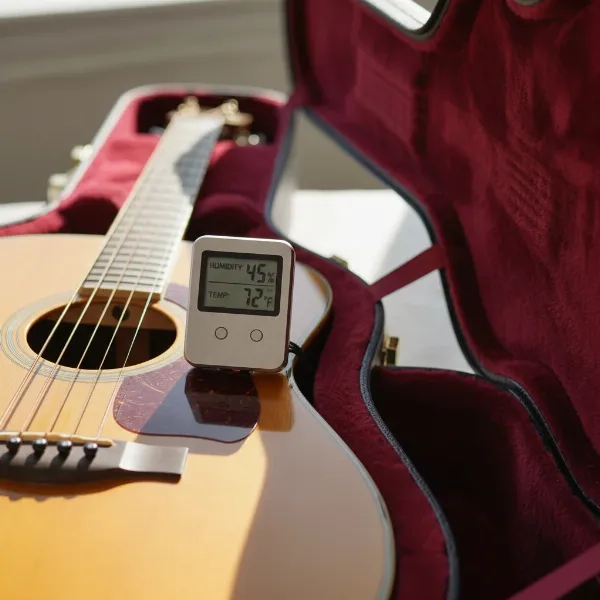 A compact digital hygrometer inside an open acoustic guitar case, clipped to the strings or resting in a compartment, showing a humidity reading on its display. The guitar body is visible.
Room Digital Hygrometers
For musicians who store multiple instruments in a dedicated room, or for those who simply want to monitor the ambient conditions of their living space, room digital hygrometers are ideal. These devices typically feature larger displays for easier reading from a distance and may offer more advanced functions like alarms for out-of-range conditions, min/max memory, and even Bluetooth connectivity for remote monitoring via a smartphone app. They can be tabletop units with a kickstand or wall-mountable, providing a broader overview of the environmental conditions where your instruments are kept. Examples include popular models from brands like AcuRite, SensorPush, and ThermoPro.
Integrated Hygrometers
Some instrument humidification systems, especially those designed for cases, come with an integrated digital hygrometer. These all-in-one solutions offer convenience by combining humidity monitoring with active humidity control. While practical, it’s always wise to periodically verify their accuracy, as with any hygrometer, to ensure your instrument remains in its optimal “safe zone.” These can be a great option for those seeking a streamlined approach to instrument care.
Comparison Table of the Best Digital Hygrometers Available Today
Choosing the right digital hygrometer can feel overwhelming with the variety of options on the market. Here’s a comparison of some highly-regarded models frequently used by musicians, highlighting their key features and what makes them stand out for instrument care.
| Brand/Model | Type | Key Features | Accuracy (RH) | Price Range (Est.) | User Note/Best For |
|---|---|---|---|---|---|
| MusicNomad Hone MN312 | In-Case/Clip-on | Clips to strings, monitors every 20s, min/max, fits Humitar, safe zone reminder | ±3% | Mid-range | Guitarists needing precise in-case readings |
| Oasis OH-2 (with OH-1) | In-Case | Often bundled with humidifier, can use holder near soundhole, compact | ±5% | Low-mid range | Simple in-case monitoring alongside Oasis humidifiers |
| D’Addario HTS | In-Case | Programmable set point, high/low memory with date/time, F/C temperature | ±3% | Mid-range | Detailed environmental history for individual instruments |
| AcuRite 01080M Pro | Room/Tabletop | Professional accuracy, manual calibration, real-time data, customizable alarms | ±2% | Mid-range | Room monitoring, high precision, alerts |
| SensorPush HT1 | Room/Case (BT) | Bluetooth connectivity (100m range), data logging, small form factor, long batt | ±3% | Mid-high range | Remote monitoring, historical data, versatile placement |
Note: Price ranges are approximate and can vary based on retailer and promotions. Accuracy figures are typical manufacturer specifications; actual performance may vary.
Guide to Choosing the Right Digital Hygrometer for Musical Instruments
Selecting the perfect digital hygrometer involves more than just picking the first one you see. Careful consideration of your specific needs and the instrument’s requirements will ensure you make an informed decision.
Determine Your Usage Needs
Start by asking yourself where and how you plan to use the hygrometer. Are you looking to monitor a single instrument kept in its case, a collection of instruments in a dedicated music room, or perhaps a large space like a studio? Your primary use case will dictate the type of hygrometer best suited for you. For instruments stored in cases, a compact, in-case model is essential. If you have multiple instruments displayed or stored in a room, a room hygrometer with a larger display and potentially smart features might be more practical. Consider if you need a device that travels with your instrument or one that stays stationary.
Factors to Consider When Buying
Several technical specifications and features contribute to a hygrometer’s effectiveness for musical instrument care:
- Accuracy and Resolution: For delicate wooden instruments, precision is key. Look for models with an accuracy of ±2-3% RH. Resolution typically refers to the smallest change the device can detect (e.g., 0.1% RH).
- Measurement Range: Ensure the hygrometer can accurately read within the critical 40-60% RH range, as well as broader extremes, to give you a full picture of potential risks.
- Response Time: A faster response time means quicker updates on humidity changes, allowing you to react more promptly to protect your instrument. Some devices update every 10-20 seconds.
- Battery Life: For wireless or in-case models, a long battery life (e.g., 1-2 years) reduces the hassle of frequent replacements.
- Display: A clear, easy-to-read LCD display is vital, especially if you plan to monitor it frequently. Backlighting can be a bonus for low-light conditions.
- Brand Reputation and Reviews: Opt for reputable brands known for quality instrument accessories or environmental monitoring devices. User reviews often highlight real-world performance and reliability.
- Placement and Mounting Options: Consider if you need a kickstand for tabletop use, a wall-mount option, or a specialized design for in-case placement (e.g., string clip, soundhole holder).
Budget
Digital hygrometers vary significantly in price, generally correlating with their features and accuracy. Basic models are very affordable, while those with professional accuracy, Bluetooth connectivity, or data logging capabilities will be at a higher price point. Remember that investing in a reliable hygrometer is a small cost compared to the potential expense of repairing a damaged instrument. Prioritize accuracy and reliability within your budget to ensure your instrument receives the best possible care.
How to Use and Maintain Your Digital Hygrometer
Proper usage and regular maintenance are crucial for ensuring your digital hygrometer provides accurate and reliable readings over its lifespan, effectively safeguarding your musical instruments.
To begin using your hygrometer, first, read the manufacturer’s manual, as specific models may have unique features or setup requirements. For in-case models, place it near the body of the instrument, avoiding direct contact with the instrument itself or any humidifier. If using a room hygrometer, position it in a central location within the room where your instruments are stored. Ensure it is away from direct sunlight, heating or cooling vents, windows, doors, or any sources of localized humidity or extreme temperature fluctuations that could skew readings. Allow the device sufficient time (usually a few minutes to an hour) to stabilize and acclimate to the environment before taking initial measurements.
Maintaining your hygrometer primarily involves keeping its sensors clean and ensuring adequate power. Regularly wipe the exterior of the device and the sensor area with a soft, dry cloth to prevent dust and debris buildup, which can impede accuracy. Avoid touching the sensor element with bare hands or using any liquids, as contaminants can cause sensor drift and damage. For battery-powered digital units, routinely check and replace batteries to prevent erratic readings or device failure.
One of the most critical aspects of maintenance is calibration. Over time, all hygrometers can drift from their original accuracy due to environmental factors, vibrations, or natural aging of the sensor. Regular calibration ensures your device continues to provide trustworthy data. A common and effective method is the salt test:
- Place a small amount of table salt in a bottle cap or small dish and add a few drops of water to create a damp (not dissolved) paste.
- Place the salt mixture and your hygrometer inside a sealed, airtight plastic bag or container.
- Allow it to sit undisturbed for at least 24 hours (some sources suggest 8-12 hours, but 24 is safer for equilibrium).
- After this period, the humidity inside the sealed environment should stabilize at approximately 75% RH.
- Compare your hygrometer’s reading to 75%. If it differs, note the offset. Some hygrometers allow for manual adjustment; others require you to simply remember the offset and apply it mentally to future readings.
Experts recommend calibrating your hygrometer every few months, or at least every 6-12 months, especially if it’s frequently moved or exposed to varying conditions.
“Regular calibration is crucial for optimal performance, akin to tuning a musical instrument to ensure harmony.”
This ensures that your humidity monitoring remains reliable and your instruments stay protected.
Common Problems and Solutions with Digital Hygrometers
Even the best digital hygrometers can encounter issues that affect their performance. Understanding these common problems and their solutions can help you maintain consistent and accurate environmental control for your musical instruments.
1. Inaccurate or Inconsistent Readings: This is perhaps the most frequent complaint.
- Problem: Readings are consistently off, or fluctuate wildly without apparent environmental changes.
- Causes: Sensor drift (natural aging), low battery, sensor contamination, poor calibration, or improper placement.
- Solution:
- Recalibrate: Perform the salt test (as described above) to check and, if possible, adjust your hygrometer. Digital hygrometers from reputable brands generally hold accuracy better than analog ones, but all can drift.
- Check Battery: A dying battery can cause erratic readings. Replace it with a fresh one.
- Clean Sensor: Gently wipe the sensor area with a soft, dry cloth. Avoid touching it with bare hands or using liquids.
- Relocate: Ensure the hygrometer is not near heat sources, direct sunlight, vents, or areas with drafts or sudden temperature changes. It should be in a representative location for the instrument’s environment.
2. Slow Response Time: The display doesn’t seem to update quickly enough after a change in humidity.
- Problem: Readings take a long time to reflect current conditions.
- Causes: This can sometimes be normal for certain models or designs, or it might be due to insufficient airflow around the sensor.
- Solution: While some inherent slowness might be unavoidable for less expensive models, ensure the hygrometer is in a spot with adequate air circulation, not tucked away in a corner or covered.
3. Display Issues (Fading, Blank, or Error Messages):
- Problem: The screen is dim, blank, or shows an error code.
- Causes: Critically low battery, extreme temperatures affecting the LCD, or internal malfunction.
- Solution: Replace the batteries immediately. If the issue persists after a fresh battery, try moving the device to a moderate temperature environment. If still unresponsive, it may indicate a defect or damage, and contacting the manufacturer’s support might be necessary.
4. Sensor Contamination or Damage:
- Problem: The sensor element gets dirty, wet, or physically damaged.
- Causes: Improper handling, exposure to dust, chemicals, or direct water.
- Solution: Prevention is key. Always handle the hygrometer carefully, particularly the sensor area. Avoid using sprays or cleaning agents near it. If the sensor is visibly dirty, gently brush it with a soft, dry brush. If damaged by water or chemicals, replacement might be the only option as cleaning a contaminated sensor can often cause further damage.
By being proactive in addressing these common issues, you can ensure your digital hygrometer remains a reliable guardian for your musical instruments.
Conclusion
Protecting your musical instruments from the damaging effects of improper humidity is a non-negotiable aspect of responsible ownership, and a digital hygrometer is your most reliable ally in this endeavor. From safeguarding the delicate wood of an acoustic guitar against cracks and warping to preserving the intricate mechanisms of a piano, consistent humidity control is paramount. By understanding the different types of hygrometers available, carefully considering your needs and budget, and diligently applying proper usage and maintenance practices, you empower yourself to create an optimal environment for your cherished instruments.
Choosing the right digital hygrometer – whether it’s a compact in-case unit or a feature-rich room monitor – is a small investment that yields immense returns in the longevity, playability, and beautiful tone of your musical instruments. Don’t let environmental neglect silence your music prematurely. What steps will you take today to ensure your instruments are living in their perfect humidity harmony?
Frequently Asked Questions
What is the ideal humidity for musical instruments?
The ideal relative humidity for most wooden musical instruments, such as guitars, violins, and pianos, is generally between 40% and 60% RH. Many experts recommend maintaining an even tighter range, specifically 45% to 50% RH, to prevent issues like cracking, warping, or swelling of the wood and to preserve the instrument’s tone and playability.
How often should I check my instrument’s humidity?
It’s advisable to check your instrument’s humidity daily, especially if it’s stored outside a climate-controlled environment or if you live in an area with significant seasonal humidity fluctuations. Consistent monitoring allows you to quickly detect and address any deviations from the optimal range, preventing potential damage.
Can I use any digital hygrometer for my instrument?
While many digital hygrometers can measure humidity, those specifically designed for musical instruments or offering high accuracy (±2-3% RH) are best. In-case models are crucial for instruments stored in their cases, while general room hygrometers are suitable for monitoring larger spaces where instruments are kept.
How often should a digital hygrometer be calibrated?
A digital hygrometer should ideally be calibrated every few months, or at least every 6-12 months. Regular calibration, such as using the salt test method, ensures that the device provides accurate readings, as sensor accuracy can drift over time due to various environmental factors and wear.
What happens if my instrument is exposed to too much humidity?
Excessive humidity can cause wooden instruments to swell, leading to issues like warping, rising string action, sticky keys, or buzzing notes. High moisture levels can also weaken glue joints, make the instrument’s tone muffled, and encourage the growth of mold or mildew, especially within instrument cases.
What happens if my instrument is exposed to too little humidity?
Too little humidity causes wooden instruments to dry out and shrink. This can lead to serious damage such as cracks in the wood, sharp fret ends, separated glue joints, and a brittle, lifeless tone. Severe dryness can permanently alter the instrument’s structure and render it unplayable.