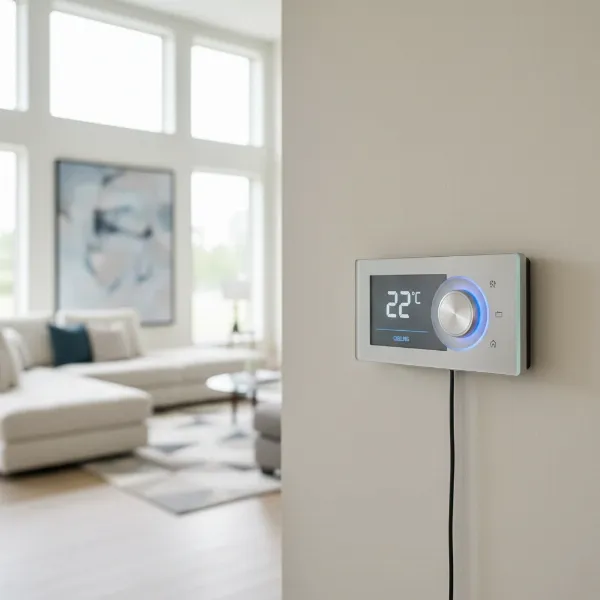
Navigating the world of home air quality can be complex, especially when dealing with invisible elements like humidity. Many homeowners grapple with understanding the difference between a digital hygrometer and a dehumidifier, often confusing their roles. While both are crucial for maintaining a healthy indoor environment, they serve fundamentally distinct purposes. One is your eyes, giving you precise insights into the moisture content of your air, while the other is your active hand, working to bring those levels into balance. Knowing when and how to use each device is key to protecting your health, preserving your home, and ensuring optimal comfort. Let’s delve into these essential tools and uncover how they work together to create an ideal living space.
Digital Hygrometer: Your Essential Humidity Monitor
What exactly is a digital hygrometer, and how does this compact device play such a vital role in our homes? At its core, a digital hygrometer is an instrument designed to measure and display the relative humidity (RH) in the air, often accompanied by temperature readings. It acts as your personal air quality reporter, giving you real-time data about the unseen moisture around you.
These devices operate using advanced electronic sensors, typically capacitive or resistive, that react to the amount of water vapor in the air. As the moisture levels fluctuate, the electrical properties of these sensors change, converting this information into a precise digital signal that is then presented on an easy-to-read LCD screen. Unlike older analog models, digital hygrometers offer high precision, often within a 1-2% margin of error, and provide instant updates, allowing for accurate monitoring of even minor humidity shifts.
The importance of measuring humidity cannot be overstated. From a health perspective, maintaining optimal humidity levels (generally between 30% and 50%) can significantly reduce allergens like dust mites and mold, alleviate respiratory issues, and prevent dry skin, irritated eyes, or static electricity. For your home and belongings, consistent monitoring helps preserve wooden furniture, musical instruments, and electronics, preventing damage like warping, cracking, or corrosion. Moreover, simply knowing your indoor humidity contributes to overall comfort, making your living space feel more pleasant regardless of the season. Digital hygrometers come in various forms, including portable handheld units for spot-checking, convenient desktop models, and sleek wall-mounted versions that blend seamlessly into your home. Some advanced models even feature data logging, trend tracking, and customizable alarms to notify you when humidity moves outside your preferred range.
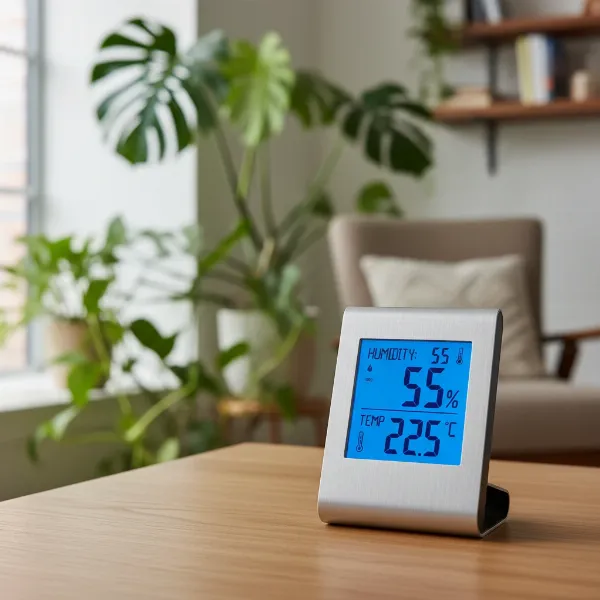 A sleek, modern digital hygrometer displaying humidity and temperature readings on an illuminated LCD screen, placed on a wooden desk with indoor plants.
Dehumidifier: Your Active Humidity Controller
While a digital hygrometer tells you the humidity story, a dehumidifier is the device that writes a new, drier chapter when needed. A dehumidifier is an appliance specifically designed to actively remove excess moisture from the air, thereby lowering the relative humidity in a room or entire home. It’s an essential tool for environments prone to dampness, offering a practical solution to combat overly humid conditions.
The most common types of dehumidifiers work on a refrigeration principle. They draw in humid air from the room, pass it over a cold coil, which causes the water vapor to condense into liquid water. This collected water drips into a removable reservoir or is routed to a continuous drain. The now-drier, slightly warmed air is then released back into the room, reducing the overall humidity. Desiccant dehumidifiers, another type, use moisture-absorbing materials to achieve a similar effect, often performing better in cooler environments.
Controlling humidity is crucial for several reasons. High humidity creates an ideal breeding ground for mold, mildew, and dust mites, all of which can trigger allergies and asthma symptoms. Beyond health concerns, excess moisture can cause significant damage to your home’s structure, leading to warped wooden floors, peeling paint, or even compromised drywall. It can also harm electronic devices, musical instruments, and important documents. Furthermore, a muggy, sticky environment is simply uncomfortable. By actively managing humidity, a dehumidifier not only protects your property and health but also enhances your sense of comfort, allowing your air conditioning system to work more efficiently and potentially reducing energy costs. Dehumidifiers come in various sizes and types, from portable units suitable for single rooms or basements, to whole-house systems integrated with your HVAC, and specialized crawl space models.
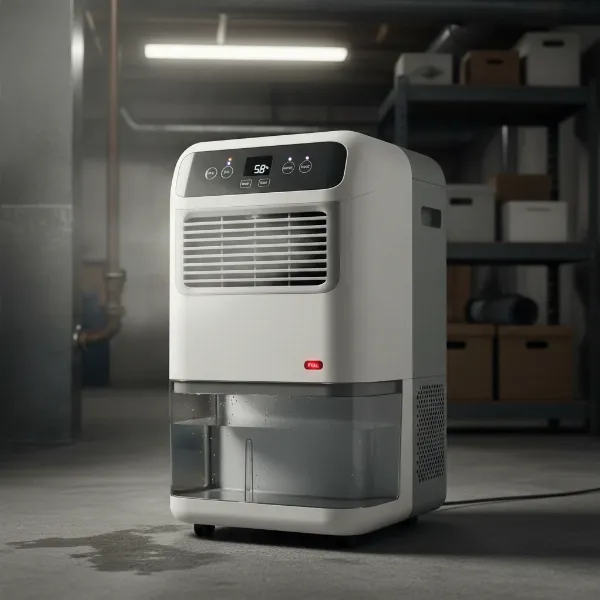 A contemporary portable dehumidifier actively running in a slightly damp basement corner, with visible water reservoir and controls.
The Core Differences: Monitor vs. Control
Understanding the fundamental distinctions between a digital hygrometer and a dehumidifier is paramount to effective home humidity management. While they both relate to indoor moisture, their functions are entirely separate and complementary.
A digital hygrometer is a passive monitoring device. Its sole purpose is to measure and display the current relative humidity. Think of it as a thermometer for moisture; it provides information without altering the environment. It’s a diagnostic tool, essential for understanding your starting point and tracking changes.
In contrast, a dehumidifier is an active control device. Its job is to remove excess moisture from the air, thereby changing the humidity levels. It’s an operational appliance, actively working to manipulate the environment.
Here’s a breakdown of their core differences:
| Feature | Digital Hygrometer | Dehumidifier |
|---|---|---|
| Primary Function | Measures and displays humidity | Removes excess moisture from the air |
| Action | Passive monitor | Active controller/modifier |
| Purpose | Information gathering, trend tracking | Humidity reduction, mold prevention, comfort |
| Accuracy | High (typically ±1-2% RH) for measurement | Built-in humidistats less precise (±5% RH) for control |
| Cost | Generally low to moderate | Moderate to high (significant investment) |
| Maintenance | Battery replacement, occasional calibration | Emptying water tank, filter cleaning, coil upkeep |
| Ideal Usage | Anywhere you need to know humidity levels | Spaces with excessively high humidity |
While a dehumidifier may have a built-in “humidistat” to sense humidity and activate its operation, this sensor is primarily for control rather than precise measurement. For true accuracy in understanding your environment, a dedicated digital hygrometer is the superior choice. Together, they form a powerful duo: the hygrometer identifies the problem, and the dehumidifier acts as the solution.
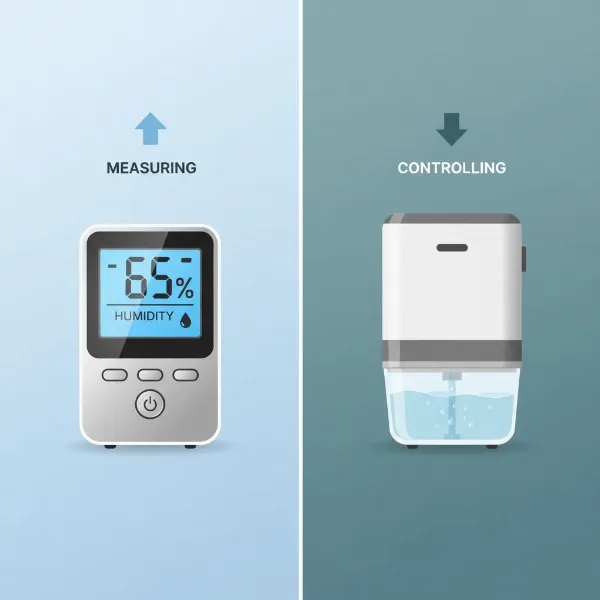 An illustrative split image contrasting a digital hygrometer measuring humidity on one side with a dehumidifier actively removing moisture on the other.
When to Choose Which: Making the Right Decision
Determining whether you need a digital hygrometer, a dehumidifier, or both, boils down to identifying your home’s specific humidity issues. The ideal indoor relative humidity range is generally considered to be between 30% and 50% for optimal health, comfort, and structural integrity.
How to Identify Humidity Problems:
- Signs of High Humidity (above 50%): You might notice a musty odor, condensation on windows, cold pipes, or walls, clammy skin, peeling wallpaper, warped wood, increased presence of dust mites or mold growth (especially in basements, bathrooms, or crawl spaces).
- Signs of Low Humidity (below 30%): Symptoms include dry skin, chapped lips, static electricity, increased susceptibility to colds or respiratory infections, cracked wooden furniture or floors, and frequent nosebleeds.
When a Digital Hygrometer is Sufficient:
If you suspect humidity issues but aren’t sure of their severity or consistency, a digital hygrometer is your first line of defense. It allows you to:
- Monitor: Get a precise, real-time reading of your home’s humidity levels.
- Diagnose: Determine if your humidity is consistently outside the ideal 30-50% range.
- Validate: Check the effectiveness of your existing HVAC system or ventilation.
- Inform Decisions: Use the data to decide if an active solution, like a dehumidifier, is truly necessary. For instance, if you experience occasional spikes that quickly dissipate with ventilation, a dehumidifier might not be a permanent need.
When a Dehumidifier is Necessary:
If your digital hygrometer consistently shows readings above 50%, especially if coupled with visible signs of excess moisture, then a dehumidifier is essential. It’s the active solution to:
- Reduce Humidity: Bring persistently high humidity levels down to a comfortable and healthy range.
- Prevent Mold & Mildew: Eliminate the conditions conducive to their growth.
- Protect Property: Safeguard your home and belongings from moisture damage.
- Improve Comfort: Make your living spaces feel less sticky and more comfortable.
For many homes, particularly those in humid climates or with damp basements, both devices are invaluable. The digital hygrometer provides continuous feedback, ensuring your dehumidifier is operating effectively and preventing the air from becoming too dry, which can lead to its own set of problems.
 A person looking thoughtfully at a digital hygrometer's reading in a home, with subtle visual cues for healthy or problematic humidity.
Maximizing Effectiveness: Usage and Maintenance Tips
To ensure your digital hygrometer and dehumidifier perform optimally and last for years, proper usage and consistent maintenance are key. These devices are investments in your home’s health and comfort, and a little care goes a long way.
For Your Digital Hygrometer:
- Strategic Placement: For the most accurate readings, place your hygrometer about three to four feet off the ground, away from direct sunlight, vents, open windows, or directly next to a running dehumidifier. These factors can distort readings. If you have multiple areas of concern, consider using several hygrometers.
- Calibration (if needed): While many digital hygrometers are pre-calibrated, some may require occasional recalibration to maintain accuracy over time. A common method is the “salt test,” where the device is placed in a sealed bag with a saturated salt solution for several hours. Consult your device’s manual for specific instructions.
- Battery Life: Digital hygrometers typically run on batteries. Keep spare batteries on hand and replace them as recommended by the manufacturer to ensure continuous monitoring.
For Your Dehumidifier:
- Optimal Placement: Place portable dehumidifiers in the dampest areas, typically basements, laundry rooms, or specific rooms with high humidity. Ensure there’s adequate airflow around the unit (at least 6-12 inches from walls and furniture) so it can draw in and expel air efficiently. Avoid placing it directly in front of air conditioning vents.
- Setting the Right Level: Most experts recommend setting your dehumidifier to maintain relative humidity between 45% and 50%. This range is effective for preventing mold growth and ensuring comfort without making the air too dry.
- Regular Water Tank Emptying: Portable units require frequent emptying of the water reservoir. If the tank fills up, the unit will typically shut off automatically. For convenience, many models offer a continuous drain option using a hose, which is ideal for basements with floor drains.
- Filter Cleaning: Dehumidifiers have air filters that collect dust and airborne particles. Clean or replace these filters every few weeks or months, depending on usage, to maintain efficiency and air quality. A dirty filter can restrict airflow and reduce the unit’s effectiveness.
- Coil Cleaning: Periodically inspect the dehumidifier’s coils for dust or frost. Dust can be gently removed with a brush or vacuum, while persistent frost may indicate a larger issue that requires professional attention.
- Consider a Humidistat: Many dehumidifiers come with a built-in humidistat. Utilize this feature to set your desired humidity level, and the unit will automatically turn on and off to maintain it, conserving energy and prolonging its lifespan.
By adhering to these simple usage and maintenance guidelines, you can ensure both your digital hygrometer and dehumidifier provide accurate data and effective humidity control, contributing to a healthier and more comfortable home environment.
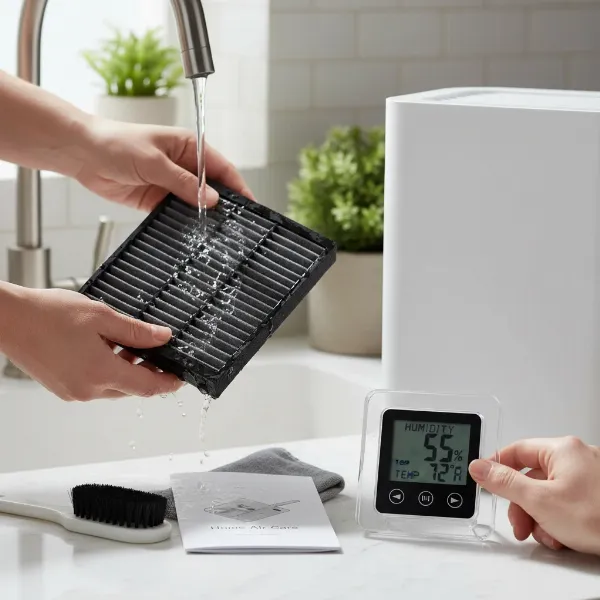 Close-up shot of hands cleaning a portable dehumidifier filter, with another hand adjusting settings on a digital hygrometer nearby.
Conclusion
Understanding the distinct roles of a digital hygrometer and a dehumidifier is fundamental to creating a truly healthy and comfortable home. While the digital hygrometer acts as your vital measuring tool, providing precise insights into the invisible moisture content of your air, the dehumidifier is your active solution, diligently working to reduce excess humidity. Neither can fully replace the other, but together, they form an indispensable team for effective humidity management.
By using a digital hygrometer to monitor your indoor environment, you gain the power to identify potential problems before they escalate, safeguarding your health, protecting your valuable possessions, and ensuring optimal comfort. When those readings consistently indicate high humidity, a dehumidifier steps in to actively remove moisture, preventing mold, mitigating allergens, and preserving your home’s structural integrity. Investing in both devices and understanding their proper usage and maintenance will empower you to confidently manage your indoor air quality, leading to a more pleasant and resilient living space. What steps will you take today to gain control over your home’s humidity?
Frequently Asked Questions
What is the ideal indoor humidity level for a home?
|
Our Picks for the Best Digital hygrometer in 2026
As an Amazon Associate I earn from qualifying purchases.
|
||
| Num | Product | Action |
|---|---|---|
| 1 | JEDEW 4 Pack Hygrometer Thermometer Digital Humidity Meter Indoor/Outdoor Humidity Monitor Reptile Thermo-Hygrometer for Greenhouse Humidors Terrarium Jars, Fahrenheit (℉) /Celsius(℃) (4) |

|
| 2 | Govee Bluetooth Hygrometer Thermometer, Large LCD, Max/Min Records, 2-Year Data Storage - Black, 2 Pack |
|
| 3 | TempPro TP49 3 Pieces Digital Hygrometer Indoor Thermometer Humidity Meter Mini Hygrometer with Temperature and Humidity Monitor Outdoor and Room Thermometer Weather Station (Previously ThermoPro) |
|
| 4 | Humidity Meter Indoor Thermometer 6-Pack Mini Digital Thermometer Hygrometer Indoor Temperature Humidity Meters Gauge LCD Display Fahrenheit (℉) for Greenhouse, Reptile Tank, Cellar, Closet |
|
| 5 | Mini Hygrometer Thermometer Digital Humidity Meter Indoor/Outdoor Humidity Monitor Reptile Thermometer for Greenhouse Garden Cellar Fahrenheit(℉)/ Celsius(℃) 2 Pack |
|
| 6 | TempPro TP50 Digital Hygrometer Indoor Thermometer Room Thermometer and Humidity Gauge with Temperature Humidity Monitor(Previously ThermoPro) |
|
| 7 | TempPro TP49 Digital Hygrometer Indoor Thermometer Humidity Meter Room Thermometer with Temperature and Humidity Monitor Mini Hygrometer Outdoor Thermometer (Previously ThermoPro) |
|
| 8 | JEDEW 2 Pack Hygrometer Thermometer Digital Humidity Meter Indoor/Outdoor Humidity Monitor Reptile Thermo-Hygrometer for Greenhouse Humidors Terrarium Jars, Fahrenheit (℉) /Celsius(℃) (2) |
|
| 9 | 6-Pack Mini Hygrometer Indoor Humidity Meter, Mini Digital Thermometer Humidity Gauge Meter, Indoor Thermometer Hygrometer Monitor Fahrenheit (℉) for Reptile Thermostat, Jars Reptile, Fridge |
|
| 10 | TempPro TP50 2 Pieces Digital Hygrometer Indoor Thermometer Room Thermometer and Humidity Gauge with Temperature Humidity Monitor(Previously ThermoPro) |
|
The ideal indoor relative humidity (RH) level for most homes is between 30% and 50%. Maintaining this range helps prevent health issues like dry skin and respiratory problems, deters mold and dust mite growth, and protects wooden furniture and electronics from moisture damage.
Can a dehumidifier replace a digital hygrometer?
No, a dehumidifier cannot fully replace a dedicated digital hygrometer. While many dehumidifiers have built-in humidistats to control their operation, these sensors are generally less accurate for precise measurement than a standalone digital hygrometer. A hygrometer provides the detailed information needed to truly monitor your home’s air quality.
How often should I check my home’s humidity?
It is advisable to check your home’s humidity levels daily, especially if you live in a climate with significant seasonal changes or have specific concerns about moisture. A digital hygrometer provides constant, real-time readings, making regular monitoring effortless and helping you identify trends or sudden fluctuations.
Will a dehumidifier help with allergies?
Yes, a dehumidifier can significantly help with allergies by reducing excess moisture in the air. High humidity promotes the growth of common allergens such as dust mites, mold, and mildew. By bringing humidity levels down, a dehumidifier creates an environment less hospitable to these triggers, potentially alleviating allergy symptoms.
Where is the best place to put a digital hygrometer?
For the most accurate readings, place your digital hygrometer in a central location in the room you wish to monitor, about three to four feet off the ground. Avoid placing it near windows, vents, direct sunlight, or directly next to a humidifier or dehumidifier, as these can affect its readings.